
Functions of Behavior-Part 2: Determining the Function or Why a Person Engages in a Specific Behavior.
Our BCBAs (Board-Certified Behavior Analysts) use something called ABC data collection to look at what happened immediately before and after a behavior occurs. It helps us identify patterns (e.g., time of day, certain activities, with specific people, etc.) and possible functions (remember escape, tangible, automatic/sensory or attention). We frequently ask our parents to collect ABC data in the home if a new behavior has popped up or if they want strategies for responding to a specific behavior.
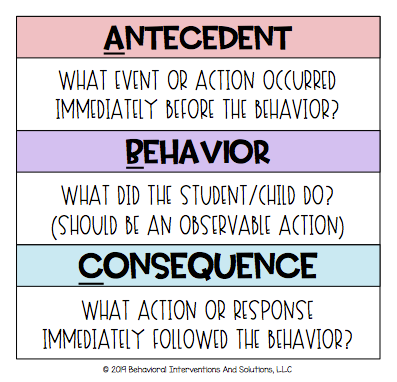
This information is used to develop a behavior support plan (BSP). A BSP includes:
- Antecedent strategies to hopefully alter the environment so the behavior does not occur
- Replacement behaviors to teach in place of the challenging behavior
- Consequence procedures to inform caregivers and staff of how to respond once the behavior has occurred
Let’s look at a couple examples:
| Antecedent: Mom tells Jimmy it is time to clean up Behavior: Jimmy starts throwing the toys and runs away Consequence: Mom cleans up for Jimmy In this instance, mom has likely reinforced the behaviors (i.e., throwing and running away) and has shown Jimmy he does not have to listen to her instructions. Based on this antecedent, the function of throwing and running away was to escape from cleaning up. |
| Antecedent: Samanatha is at the grocery store with her dad and she picks out 2 bags of candy. Dad tells her no. Behavior: Samantha drops to the ground crying and kicking her feet. Consequence: Dad gives Samantha the candy to stop her from crying. In this instance, dad has likely reinforced the behavior (i.e., tantrum) and showed Samantha she can get access to preferred items when she engages in tantrum behavior. Based on this antecedent, the function of her crying and kicking feet was to gain access to this tangible item of candy. |
These are the ways that our BCBAs assess why a certain behavior is occurring. Stay tuned for part 3 of our functions of behavior series to learn about antecedent strategies and teaching replacement skills!