
Reading Therapy helps individuals who have difficulty acquiring the language skills necessary to read, write, and spell.
Services, administered by a Certified Academic Language Therapist (CALT), aim to improve letter identification, sound blending, reading fluency, comprehension, writing, and more! The Reading Clinic at LLA Therapy embraces the science of reading, and strives to stay current with recommendations regarding the acquisition of the English language system to best serve our patients.
To learn more about Reading Therapy, and to see if it is right for your family, please see below:
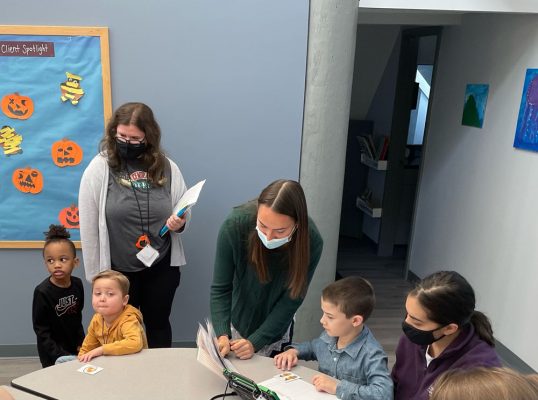
Additional Reading Therapy Information
Information on the types of reading difficulty we treat (Dyslexia, Hyperlexia, Mixed, Compensator)
- Dyslexia:
- Difficulty in developing word-level reading skills despite having adequate instructional opportunities.
- Has adequate language comprehension.
- Hyperlexia:
- Difficulties with general language comprehension.
- Adequate word-level reading skills.
- Far less common deficit.
- There is no evidence to suggest that any specific form of reading instruction is the source of hyperlexia.
- Mixed:
- Difficulties with both word-level reading and language comprehension.
- Usually these students have speech or language impairment and or intellectual disabilities.
- Compensator:
- Usually have strong language skills, reading comprehension is below their language skills, but still within the average range.
- Word reading-skills are below their comprehension skills, but still in the average range.
- Because their overall reading skills are in the average range they are often missed when diagnosing students.
- These students, teachers, and parents, might characterize their reading as effortful.
Based on Gough and colleagues simple view of reading:
Gough, P.B., & Tunmer, W. E. (1986) Decoding, reading and reading disability. Remedial and Special Education, 7, 6-10.
Kilpatrick, D.A. (2015) Assessing, Preventing, & Overcoming Reading Difficulties. Wiley: Hoboken, NJ.
I have an existing evaluation: If you have an existing educational psychological evaluation, an IEP with data and goals that support reading difficulty, or a current evaluation team report from your school district, chances are we can begin a therapy plan for your child by building upon the recommendations and goals already created. Parents who wish to enroll their child into the Reading Clinic’s therapy program with an existing evaluation will need to share their child’s reports with our staff and review your concerns. Two sixty minute sessions will be scheduled to evaluate your child’s current reading skills using curriculum and norm referenced measures to establish programing options and baseline performance.
I do not have an existing evaluation: If you do not have an existing evaluation, contact our reading staff and discuss your concerns. If it is agreed upon that moving forward with reading therapy is warranted, two sixty minute sessions will be scheduled with your child to evaluate your child’s current reading skills. Curriculum based and norm referenced measures will be utilized to establish programing options and baseline performance.
For information on appointments, insurance, office policies, and more, visit the Patient Information section of our website.
Evaluation & Therapy Process
Related Articles
Strategies for Vocabulary Intervention in Speech Therapy:
Semantic Mapping Semantic mapping is a great strategy for vocabulary intervention. Semantic mapping can be…

The Benefits Of Using a Wordless Picture Book
When choosing books for your young child, you may overlook the power of what picture…
How to Read to Your Child (Part 2)- Preschool/Elementary
Previously we discussed how to read to your baby/toddler, and in this blog post we…